
What Is a 2D Barcode? How It Works, Types, and Use Cases

Shreesh
Last updated: February 27, 2026
14 min read
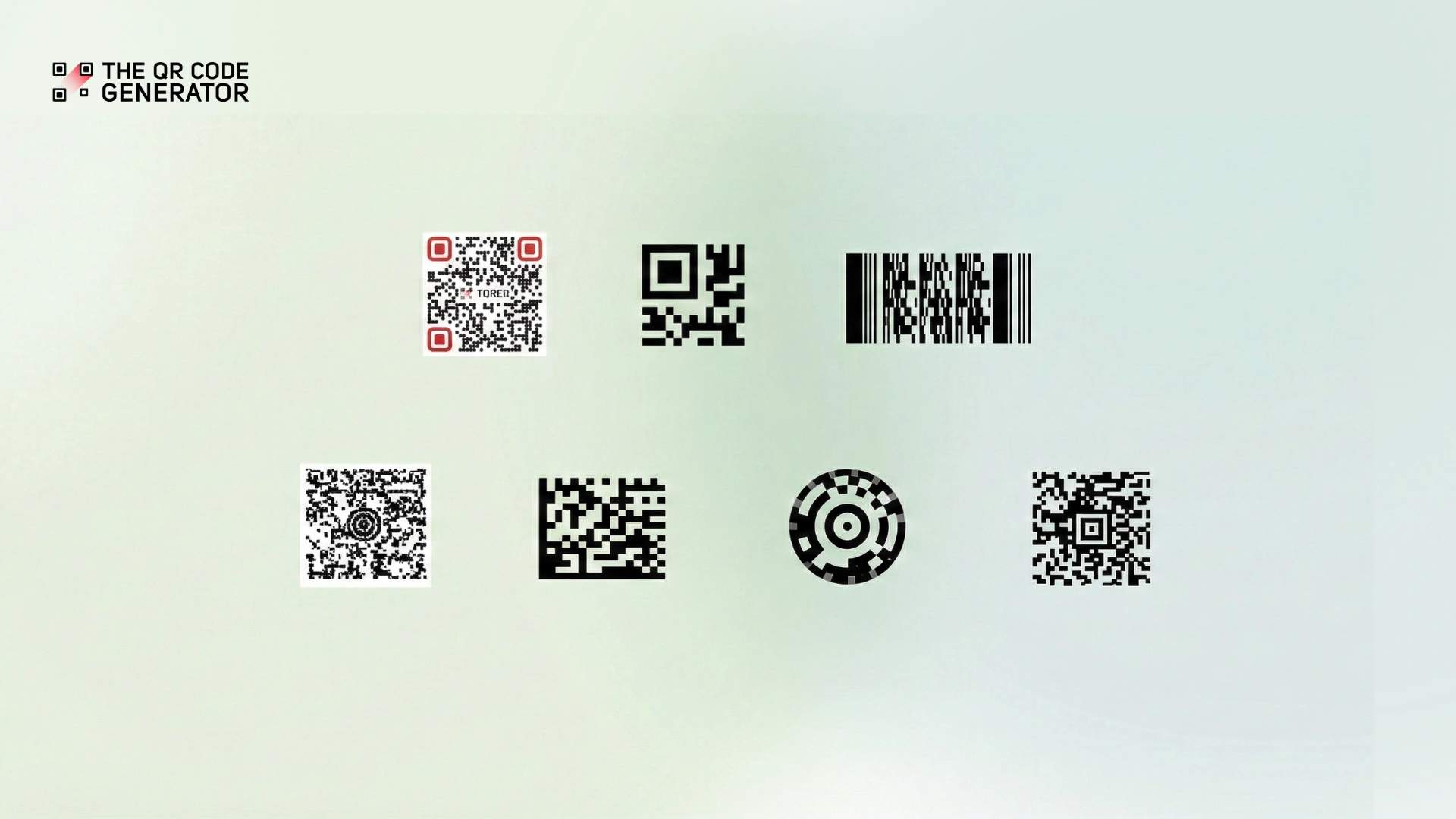
Scannable codes are everywhere, from product packaging and restaurant tables to shipping labels, event tickets, and payment screens. Many are 2D barcodes, square codes that hold more data than traditional barcodes and connect physical items to digital experiences.
But what makes them interesting is their range. The QR Code on your coffee cup and the Data Matrix etched onto a pacemaker use fundamentally the same technology, just optimized for different stakes. One connects you to a loyalty program. The other tracks a medical device that needs to function for a decade inside someone’s body.
So what exactly are 2D barcodes? How do they work, and why are businesses increasingly adopting them across industries?
This guide answers those questions. It explains the main types of 2D barcodes, how they function, where they are used, and what to consider when implementing them in real-world workflows.
What is a 2D barcode?
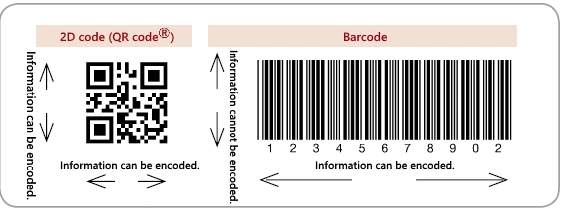
A 2D barcode stores data in both horizontal and vertical directions, unlike 1D barcodes that use only vertical lines. This structure allows 2D barcodes to hold significantly more information while supporting built-in error correction, which helps them remain scannable even when partially damaged.
The most widely recognized example is the QR Code, a square grid of black and white modules that most smartphone cameras can scan natively. Other common formats include Data Matrix, PDF417, and Aztec Codes, each designed for different environments and use cases.
Because they can encode URLs, contact details, payments, and structured data directly into the symbol, 2D barcodes have become standard across industries that require fast, reliable scanning.
Why businesses are moving to 2D barcodes
Businesses are adopting 2D barcodes because they turn a simple label into something more useful. Instead of just identifying an item, the code can carry information and trigger an action when scanned.
One small code can replace several labels, reduce manual typing, and lower the chance of errors. That’s why they’re showing up across industries, from retail and logistics to healthcare and manufacturing.
1. More information without adding more labels
A traditional 1D barcode usually stores a short ID that points to a database. A 2D barcode can include more details directly in its code. Teams can scan once and immediately see details such as batch numbers, expiration dates, serial numbers, and handling instructions.
During recalls or inspections, this saves time because staff don’t need to check multiple systems. On the customer side, a single code can work across regions by directing people to the correct language or content.
2. Easy to scan with everyday devices
Smartphones made 2D barcodes practical for everyday use. Customers can scan with their camera, and employees can use either regular phones or dedicated scanners. There’s no need for special equipment, which makes adoption easier, especially for smaller businesses.
A cafe owner, courier, or technician can all scan the same code without changing their tools.
3. Still works even when damaged
Many 2D barcodes include error correction, so they can still be scanned even if part of the code is scratched or worn. QR Codes, for example, can recover from up to about 30% damage depending on how they’re generated and printed.
This is especially valuable in harsh environments like factories, cold storage, and outdoor logistics, where dirt, moisture, and rough handling are routine.
4. Can work offline when needed
Some 2D barcodes store information directly inside the code, so scanning doesn’t always require internet access. That’s useful in warehouses, loading docks, or remote locations where connectivity isn’t reliable.
Other codes simply point to online content. Businesses can decide which approach works best based on their needs.
5. Faster scanning without careful alignment
Most 2D barcodes don’t need careful alignment. Workers can quickly scan without adjusting the scanner, which speeds up tasks such as picking, packing, or validating tickets. Nobody wants to carefully angle a scanner beam in a busy warehouse — they just want a fast scan and a beep. This also makes them easy to scan from phone screens, which is why they’re common for passes, tickets, and identity checks.
6. Update links without reprinting
Some 2D barcodes allow you to change where the code leads without reprinting it. If your website goes down, support teams can update the QR Code code to point customers to a status page instead of a broken link. When you discontinue a product, you can redirect its manual’s QR Code to the updated guide without reprinting anything.
You can also see when and where scans happen, which helps teams understand what’s working and make better decisions.
Now that you understand why businesses are adopting 2D barcodes, it helps to look at how they work behind the scenes.
How do 2D barcodes work?
A 2D barcode encodes data in a grid of dark and light modules, usually square-shaped modules arranged in a structured pattern. Scanners and smartphone cameras read the contrast between these squares and decode the information based on the barcode format.
The process involves several key steps:
- Data encoding: Information is converted into binary data (1s and 0s) and arranged into small squares within the grid. The exact encoding depends on the type of content, such as numbers, text, or binary data.
- Positioning markers: Many formats include finder or alignment patterns that help scanners detect orientation, size, and boundaries. For example, QR Codes use three large square markers in the corners, allowing them to be scanned from different angles.
- Error correction: Most 2D barcodes use Reed-Solomon error correction, which adds extra data to help recover missing or damaged areas. This allows scanning even if part of the code is obscured.
- Reading process: A camera or scanner captures the image, identifies the positioning markers, decodes the pattern, and reconstructs the original information, such as text, URLs, or IDs.
What are the types of 2D barcodes?
QR Codes are the most widely known type of 2D barcode, but they are just one of several formats. Each type is designed for different use cases, scanning environments, and data needs.
The tables below compare common 2D barcode formats based on their technical features and practical applications.
Technical considerations
| Feature | QR Code | Data Matrix | PDF417 | Aztec Code |
|---|---|---|---|---|
| Appearance | Square with three positioning markers in corners | Square or rectangular grid | Stacked linear rows (rectangular) | Square with central bullseye pattern |
| Maximum theoretical capacity | ~7,089 numeric~4,296 alphanumeric | ~3,116 numeric~2,335 alphanumeric | ~2,725 numeric~1,850 alphanumeric | ~3,832 numeric~3,067 alphanumeric |
| Error correction | Reed-Solomon (levels L, M, Q, H; approx. 7% to 30% recovery depending on level) | Reed-Solomon ECC200 with high damage tolerance | Reed-Solomon with configurable error correction levels (0–8) | Reed-Solomon with configurable, user-selectable error correction levels |
| Quiet zone required | 4 modules on all sides | Minimal quiet zone required (typically ~1 module) | Quiet zone required around symbol (size varies by implementation) | No mandatory quiet zone required (can be printed edge-to-edge) |
| Reading direction | Any 360° angle | Any 360° angle | Primarily linear orientation; less omnidirectional than matrix codes | Any 360° angle |
| Standardization | ISO/IEC 18004 | ISO/IEC 16022 | ISO/IEC 15438 | ISO/IEC 24778 |
Practical considerations
| Feature | QR Code | Data Matrix | PDF417 | Aztec Code |
|---|---|---|---|---|
| Common uses | Marketing, payments, URLs, ticketing | Small item marking, electronics, pharmaceuticals | Government IDs/driver’s licenses, transport, logistics | Boarding passes, tickets, IDs |
| Size efficiency | Medium (requires positioning markers) | High (dense encoding, minimal quiet zone) | Lower density compared to matrix codes; rectangular footprint | High (no quiet zone requirement) |
| Damage tolerance | High (up to ~30% at the highest error correction level) | High (depends on ECC200 configuration) | Adjustable depending on the error correction level | High, depending on the error correction configuration |
| Best for | General-purpose, consumer-facing applications | Small parts, limited space | Documents with large structured data | Transport tickets, space-constrained applications |
Now let’s look at each format more closely.
1. QR Code
QR Codes, or quick response codes, are the most widely recognized type of 2D barcode. They feature three large positioning markers in the corners and a grid of black and white squares that enable fast, 360° angle scanning.
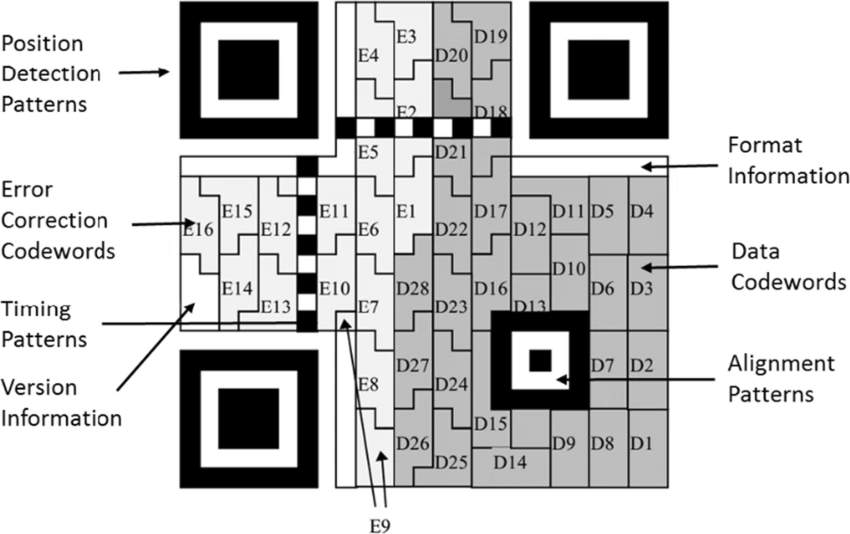
Developed by Denso Wave in 1994 for tracking automotive parts, QR Codes are now widely used in consumer and business applications. They connect physical touchpoints to digital experiences, from marketing campaigns and restaurant menus to mobile payments, event tickets, boarding passes, and two-factor authentication workflows.
QR Codes can store up to approximately 4,296 alphanumeric characters, depending on configuration, and include selectable error correction levels ranging from about 7% to 30%. They can hold full URLs, contact details, or payment information while scanning quickly, making them ideal for many consumer-facing applications.
2. Data Matrix code
A Data Matrix is a 2D barcode made of black and white squares arranged in a grid. It includes an L-shaped pattern along two edges that helps scanners detect orientation and read the code accurately.
They look slightly different from your usual QR Code.
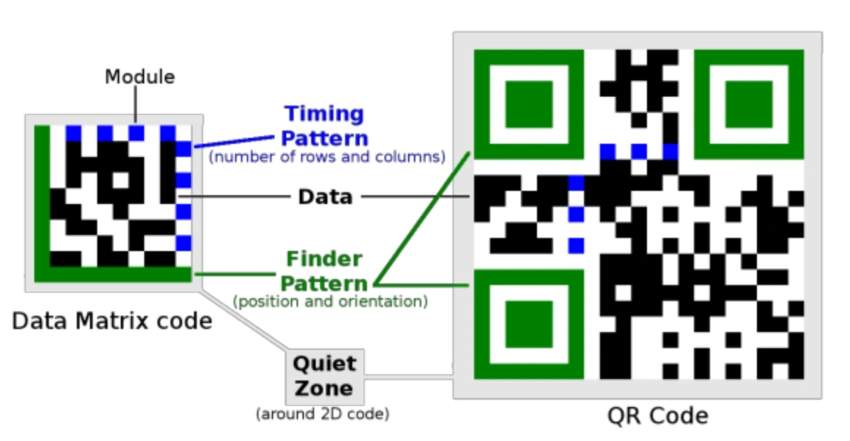
Developed in the late 1980s, Data Matrix is widely used in manufacturing, healthcare, and regulated industries where permanent marking and traceability are essential. Common applications include electronic components, surgical instruments, pharmaceutical packaging, and direct part marking on metal or plastic surfaces.
Data Matrix codes support high data density and strong error correction (ECC200), allowing reliable scanning even when codes are small or partially damaged.
3. PDF417
PDF417 is a stacked linear barcode made up of multiple rows of smaller barcode segments, forming a rectangular symbol designed to store structured data.
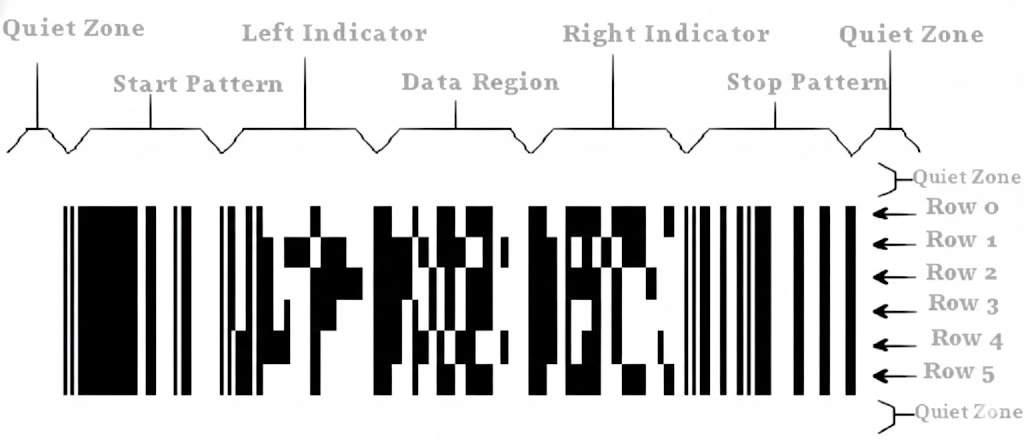
Introduced by Symbol Technologies in 1991, PDF417 stands for portable data file, with “417” referring to the pattern of bars and spaces used in encoding. Unlike QR Codes or Data Matrix codes, PDF417 can be read by older linear barcode scanners that scan each row sequentially, while modern 2D scanners capture the full symbol at once. Native smartphone camera apps may not always support direct scanning.
PDF417 can store large amounts of structured data, which is why it’s commonly used on government IDs, driver’s licenses, boarding passes, and logistics documents. Depending on the configuration, it can hold about 1,850 alphanumeric or over 2,700 numeric characters.
4. Aztec Code
An Aztec Code is a 2D barcode identified by its central bullseye finder pattern, surrounded by concentric square layers of encoded data. Unlike many other formats, an Aztec Code does not require a traditional quiet zone, allowing it to be printed efficiently in small spaces.
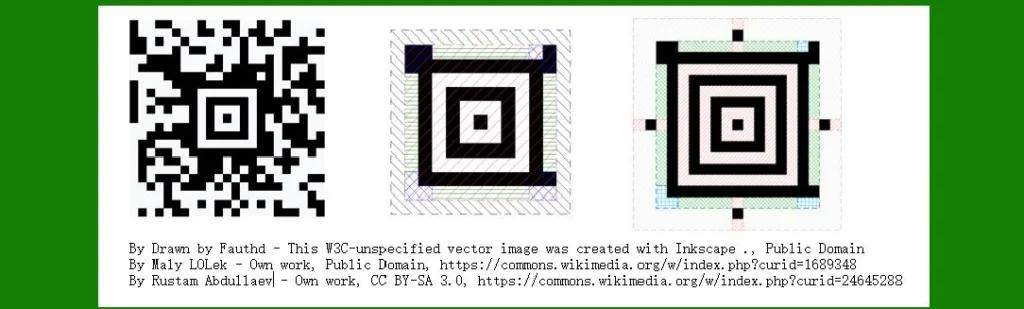
Named for its resemblance to an Aztec pyramid, the format is used in transportation and mobile ticketing environments where reliable scanning from screens is critical. Applications include rail and airline boarding passes, transit tickets, loyalty programs, and logistics tracking.
Aztec Codes support configurable error correction and can encode up to approximately 3,832 numeric or 3,067 alphanumeric characters, depending on configuration.
These advantages become clearer when you look at how different industries actually use 2D barcodes day to day.
Read more: Aztec Code vs QR Code
Where 2D barcodes are used today
2D barcodes are used when you need to store more information in a small space and scan it quickly with a phone or a scanner.
QR Codes are the most visible example and are especially common in payments and customer engagement. In payments, their growth has been especially strong. Juniper Research estimates global retail QR Code payments will rise 79% to 741 billion by 2030.
In travel, 2D barcodes have replaced mainly older ticket formats. IATA introduced the “Bar Coded Boarding Pass standard,” which includes QR Code, PDF417, Data Matrix, and Aztec Code as supported formats.
Here’s how different industries use them today.
Retail and payments rely on QR Codes
Retailers use QR Codes because they work with any smartphone camera, which means customers don’t need special apps or hardware.
You’ll commonly see them on:
- Tap-to-pay signs at small shops and street vendors
- Restaurant tables linking to menus or ordering systems
- Product packaging that leads to more information or promotions
- Loyalty programs and digital coupons scanned at checkout
Travel and entertainment favor Aztec and PDF417
Airlines, transit systems, and event venues need codes that scan quickly and reliably, even from phone screens or in busy environments.
Typical examples include:
- Airline boarding passes and baggage tags
- Concert and stadium tickets
- Transit passes scanned from mobile wallets
Aztec codes in particular earn their place here. Their high damage tolerance means a cracked phone screen or a creased printout rarely causes a problem at the gate. The IATA boarding pass standard helped make barcode-based boarding universal by the early 2010s.
Healthcare and manufacturing require Data Matrix codes
Industries that require strict tracking and traceability often choose Data Matrix because it stays readable even when printed very small or exposed to wear.
Common uses include:
- Pharmaceutical packaging for serialization and recalls
- Surgical instruments tracked through cleaning and sterilization
- Electronics components marked directly on circuit boards
- Automotive parts tracked throughout their lifecycle
Logistics and supply chain use multiple formats
Logistics teams usually combine formats depending on the job. A single label might include different codes for different systems or users.
Examples include:
- Shipping labels designed for warehouse scanners (PDF417)
- Customer-facing tracking links using QR Codes
- Inventory tracking using Data Matrix
- Utility bills with QR Codes for quick payments
How to create your own 2D barcode (QR Code)
If you want to start using 2D barcodes right away, creating a QR Code is the fastest path. Tools such as The QR Code Generator (TQRCG) make it easy to create and manage QR Codes in minutes.
Step 1: Decide what you want the code to do
Start by defining the goal. Typical uses include linking to a website, sharing a document, collecting payments, or providing contact details.
You’ll also choose between:
- Static QR Codes, where the destination is fixed.
- Dynamic QR Codes, which let you update the destination later without reprinting the code.
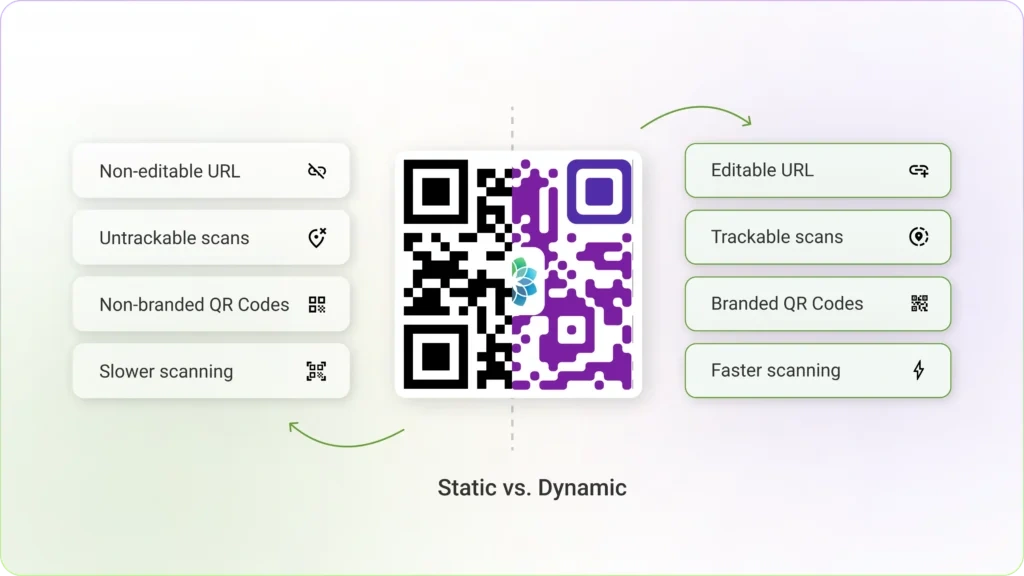
Step 2: Pick your QR Code
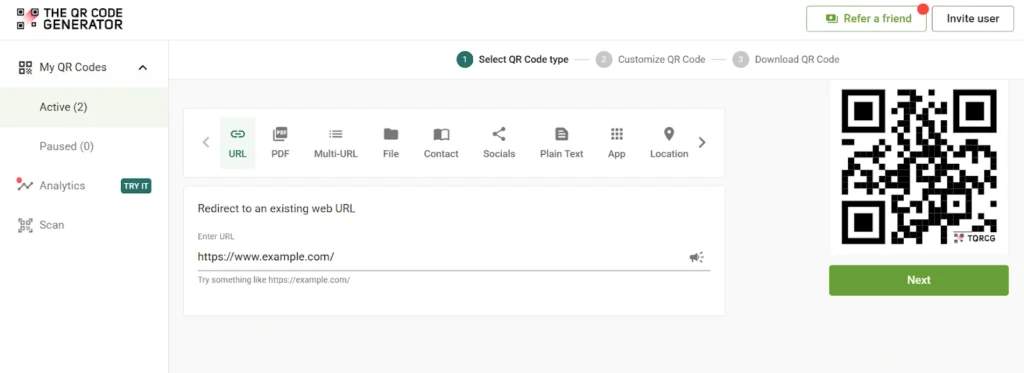
Log in to The QR Code Generator (TQRCG). Then, select your QR Code type from options such as URL, PDF, Socials, etc., and fill in the required information.
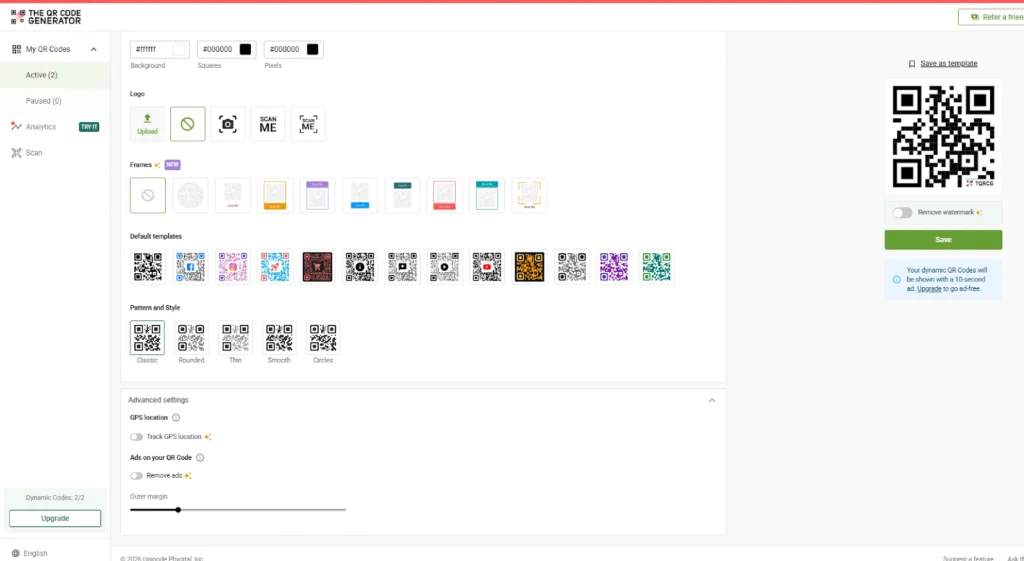
Step 3: Design your QR Code
Add your logo for brand recognition. Choose a template and customize the colors to match your brand, or keep the design simple. TQRCG checks your design as you customize, so your choices don’t accidentally make the code unscannable.
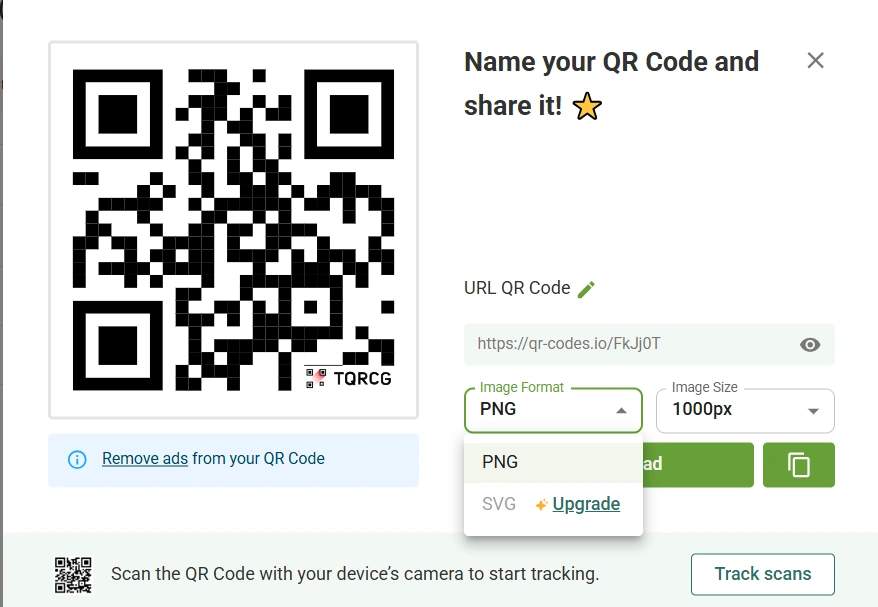
Step 4: Download and test
Select the correct QR Code format based on your requirements, name your QR Code, and download it. Always scan the preview at different distances on both iOS and Android before printing in large batches. It takes 30 seconds and can save a costly reprint.
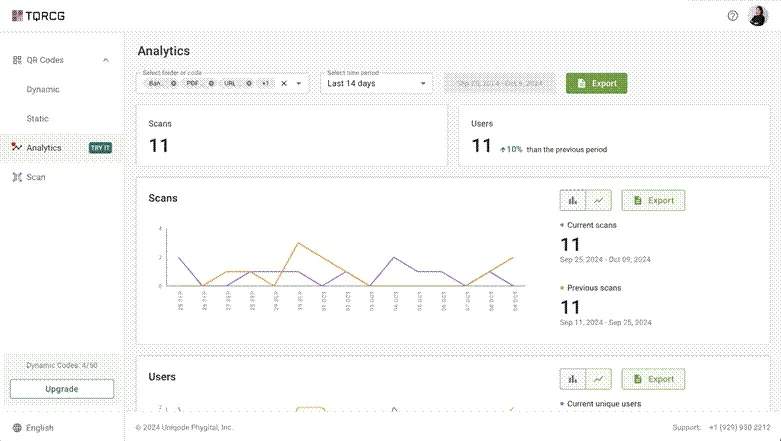
Step 5: Launch and monitor
If you’re using a dynamic QR Code, you can update the destination later and track scan activity to understand how people interact with it. Log in to your TQRCG analytics dashboard to access insights such as scan metrics, geographic data, and device breakdowns.
Finally, let’s answer the final big question.
Are 2D barcodes secure enough?
2D barcodes themselves are not inherently unsafe. The danger lies in where they send you.
A QR Code can open a website or trigger a login page, and users usually only see the destination after scanning. This gap between scan and destination is exactly what attackers exploit.
Attackers replace legitimate codes with malicious ones or redirect users to fake websites, a tactic often called “quishing.” The FBI has also warned about scams where criminals place fake QR Code stickers over legitimate ones on parking meters, restaurants, and public signage, turning a trusted interaction into a trap.
Despite these risks, global standards and industry frameworks help ensure that 2D barcodes remain reliable and secure when implemented correctly.
International Organization for Standardization (ISO) requirements
The International Organization for Standardization (ISO) defines the technical specifications that ensure 2D barcodes work consistently across devices and systems.
Key standards include:
- ISO/IEC 18004 for QR Codes
- ISO/IEC 16022 for Data Matrix, including ECC200 error correction
- ISO/IEC 15438 for PDF417
- ISO/IEC 24778 for Aztec Code.
These standards define how data is encoded, structured, and read by scanners, helping prevent compatibility issues and ensuring reliable performance across industries.
ISO also establishes barcode quality verification through ISO/IEC 15415, which grades symbols from A (4.0) to F (0.0) based on factors such as contrast, modulation, and fixed-pattern damage. Maintaining higher grades reduces scanning errors and supports consistent performance in supply chains.
GS1 standards and the Sunrise 2027 initiative
While ISO defines how barcodes work technically, GS1 sets the data standards used in global commerce.
GS1 standards allow products to be identified and tracked consistently across retailers, manufacturers, and logistics systems worldwide. One of the most important current initiatives is GS1 Sunrise 2027, which aims to transition retail scanning from traditional 1D barcodes to 2D barcodes at the point of sale.
Under this initiative:
- Retailers are preparing systems to scan both 1D barcodes and newer 2D formats.
- Manufacturers are adding GS1 QR Codes (using Digital Link) or GS1 DataMatrix codes alongside existing UPC barcodes.
- More product information becomes available at scan, including batch numbers, expiration dates, serial numbers, and links to digital product data.
This shift supports faster recalls, improved traceability, anti-counterfeiting efforts, and stronger regulatory compliance across industries such as healthcare, food, and retail.
Sunrise 2027 is an industry-led transition rather than a single global regulation. During the rollout, many products will carry both 1D and 2D barcodes until scanning systems are fully updated.
Get your first working 2D barcode with TQRCG
2D barcodes are quickly becoming standard across industries.
For many businesses, QR Codes are the easiest place to start. They’re simple to create, widely supported by smartphones, and flexible enough to work across packaging, signage, and customer experiences.
If you’re ready to put this into practice, The QR Code Generator (TQRCG) makes it easy to create and manage QR Codes without adding complexity. You can generate codes quickly, customize their appearance, and update destinations later when using dynamic QR Codes.
Sign up to try TQRCG today and ship your first set of QR Codes in minutes!
Frequently Asked Questions
Is a QR Code the same as a 2D barcode?
A QR Code is a type of 2D barcode, but not all 2D barcodes are QR Codes. QR Codes are the most popular and smartphone-friendly variant, while Data Matrix, PDF417, and Aztec Codes have unique use cases suited to their strengths.
Do I need special hardware to scan 2D barcodes?
Most 2D barcodes (especially QR Codes) scan with any smartphone camera. Enterprises may use dedicated 2D imaging scanners for high-volume scanning or to read specialized types such as Data Matrix codes or PDF417.
Can 2D barcodes expire?
The code itself doesn't expire; it's just a pattern. However, dynamic QR Codes that redirect to URLs can be deactivated by the service provider. A static code that links directly to your content never expires.
How small can a 2D barcode be and still scan?
It depends on the type and scanning distance. QR Codes need at least 1 × 1 inch for smartphones, while Data Matrix codes can go as small as 2.5 mm with industrial scanners. Use the 10:1 distance-to-size ratio rule: 1 cm of code per 10 cm of scanning distance.
Why are retailers transitioning to 2D barcodes?
The GS1 Sunrise 2027 initiative pushes retailers to adopt 2D barcodes (QR Codes and Data Matrix codes) to embed more product information (batch numbers, expiry dates, digital product pages) rather than just a lookup code. This enables better traceability and richer customer experiences.