
Aztec Code vs. QR Code: What’s the Difference?

Shreesh
Last updated: April 23, 2026
8 min read
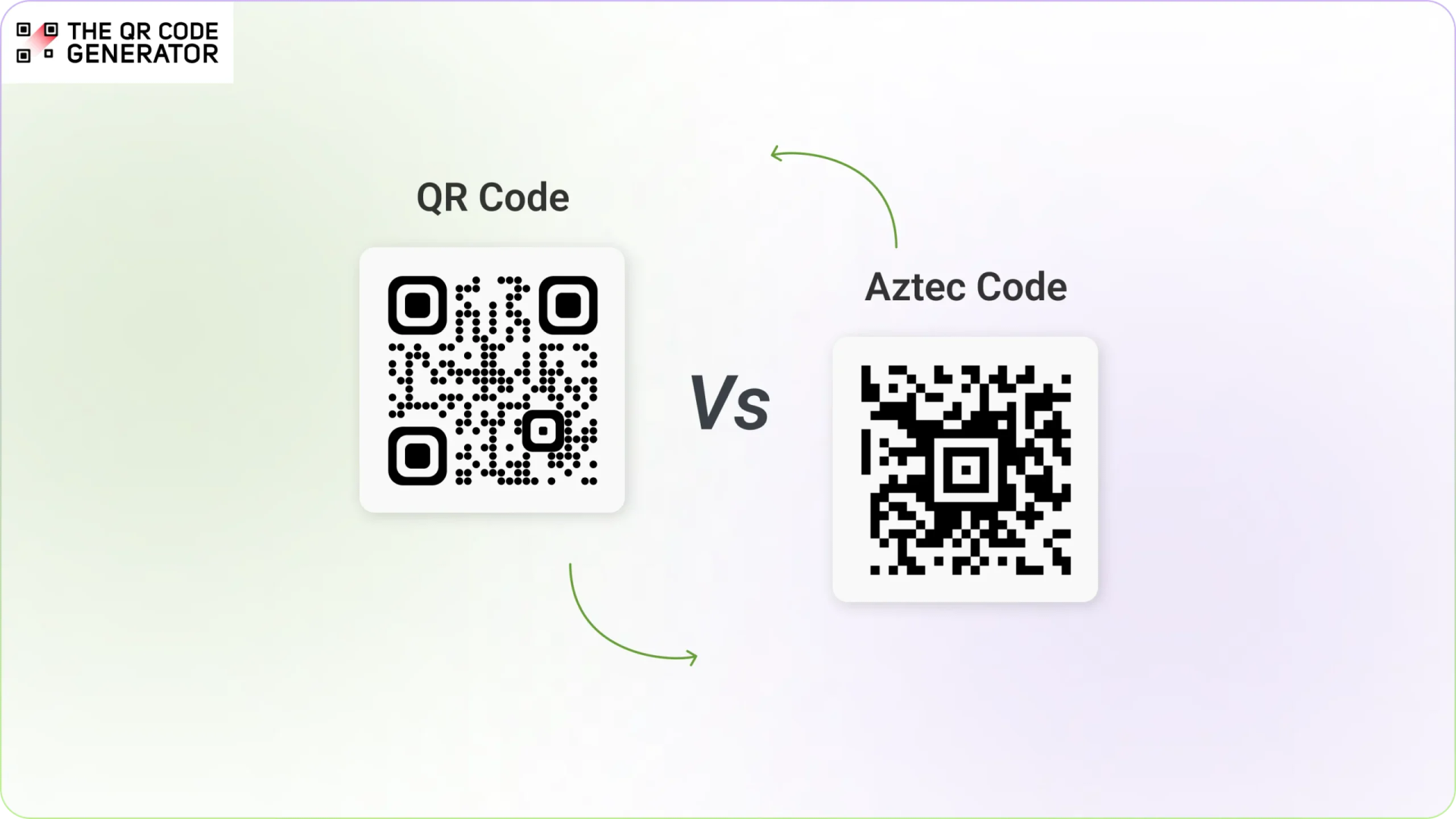
Both QR Codes and Aztec Codes are 2D barcodes made of tiny black-and-white squares. Both can store URLs or text, and both can be scanned using camera-equipped devices. But despite their similarities, they’re built with different priorities in mind.
QR Codes are built for universal recognition and widespread compatibility across smartphones, apps, and marketing use cases. Aztec Codes, on the other hand, are optimized for compact size and reliable scanning in constrained environments such as tickets or small labels.
Now, the question is: which one should you choose for your business? This article uncovers all the differences and tells you where and when to pick one over the other.
What you need to know about QR Codes
QR Codes, or Quick Response Codes, are square 2D barcodes that can be scanned with a smartphone camera to open links or display information. Because they store data both horizontally and vertically, they can hold more information than traditional 1D barcodes.
QR Codes are used to store and quickly share information such as website links, payment details, product information, and contact data. Their biggest advantage is standardization and recognition. Most modern smartphone cameras support QR Code scanning natively, making them ideal for customer-facing experiences.
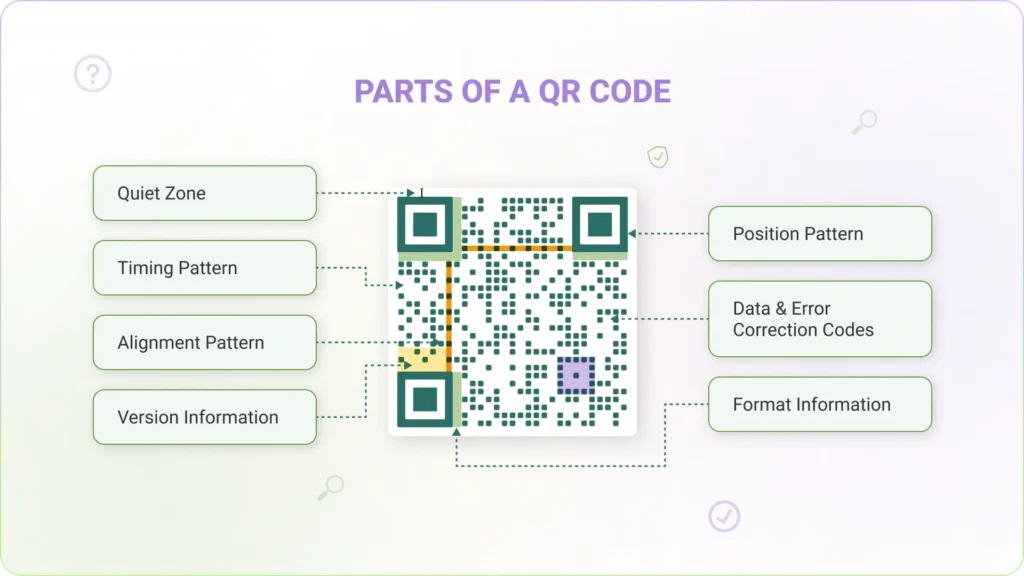
The parts of a QR Code play a key role in how scanners accurately decode it. The three large corner squares help the scanner detect the code and determine its orientation (i.e., which way it’s rotated). A blank border called the quiet zone helps separate the code from the background so scanners don’t get confused.
What you need to know about Aztec Codes
Aztec Code is another 2D barcode format designed to store data compactly and scan reliably, especially when space is limited. It can hold text or links like a QR Code, but it works well in tight spaces because it doesn’t require a large blank margin.
They are commonly used in transportation and logistics, including rail and airline ticketing, because they scan reliably from both printed materials and phone screens.
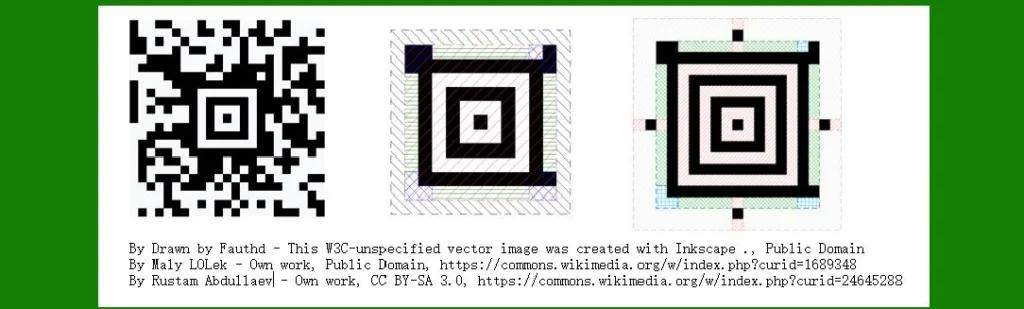
Aztec Codes feature a distinctive central pattern made of concentric squares (often called a bullseye). Scanners detect this center first, which helps maintain readability even when the code is small, rotated, or scanned at an angle.
Let’s break down the key differences between QR Codes and Aztec Codes.
QR Code vs. Aztec Code: A technical comparison
QR Codes are the most widely used consumer-facing 2D barcodes and can usually be scanned with a phone’s default camera. Aztec Codes are more compact and work better in tight spaces (such as tickets or labels).
Here are the technical differences at a glance:
| Feature | QR Code | Aztec Code |
|---|---|---|
| Max data capacity | 7,089 numeric / 4,296 alphanumeric / 2,953 bytes | 3,832 numeric / 3,067 alphanumeric / 1,914 bytes |
| Error correction control | Reed-Solomon (levels L, M, Q, H; approx. 7% to 30% recovery depending on level) | Reed-Solomon with configurable error correction levels |
| Quiet zone requirements | Yes: at least 4 modules on each side | No quiet zone required |
| Smallest to largest size | 21 × 21 to 177 × 177 modules | 15 × 15 to 151 × 151 modules |
| How scanners lock on | 3 big corner squares | Central bullseye target |
Benefits of QR Codes over Aztec Codes
QR Codes are helpful in everyday life because they’re familiar and supported almost everywhere people already are. You can use QR Codes almost anywhere you think of, as long as there is a surface.
- Universal recognition advantage: QR Codes can be easily scanned with the native Android or iOS camera app without downloading any extra apps. Businesses choose QR Codes because customers already understand and recognize them everywhere.
- A strong ecosystem of tools and services: QR Codes have a strong ecosystem of tools and services. There are free QR Code generators, brand-ready templates, short-link tools, analytics dashboards, and dynamic QR Codes that let you change the destination without reprinting the code.
- Design flexibility for brand consistency: QR Codes are also easier to style for consumer-facing design. You can add a logo to your QR Code, adjust colors, and even place it inside a branded frame that tells people what they’ll get (“Scan for menu,” “Pay here,” etc.).
- Versatility across use cases: QR Codes support both simple information access and high-volume transactions. They are used for everyday actions such as opening menus, links, and product information, and they are also widely used for in-person payments.
However, Aztec Codes are useful when you need to cram more information in a limited space. Here’s how.
Benefits of Aztec Codes over QR Codes
Aztec Codes are usually the better choice when space is limited or an industry standard already supports them. That makes them a strong fit for small tickets and crowded labels where QR Codes may need more surrounding space for reliable scanning.
Aztec Codes are also well-suited to difficult scanning conditions.
They are also a practical choice in industries with established workflows, especially transportation. IATA’s Bar Coded Boarding Pass guidance includes Aztec among the supported 2D barcodes for mobile and printed boarding passes, which is one reason Aztec Codes are common in travel systems.
But which of these (QR Codes or Aztec Codes) makes more sense for you? Let’s find out.
How to choose the correct 2D barcode for your industry
Picking between QR Code and Aztec usually comes down to two questions.
- Who is scanning it (regular customers or trained staff with special scanners), and
- How much space and margin do you have around the code?
Let’s look at which one works best in various industries.
Retail and consumer products
QR Codes are the best choice for retail because shoppers recognize them. Most smartphones scan them with the default camera app, reducing friction at the point of sale and on packaging.
They work well for product landing pages, warranty registration, authenticity checks, setup instructions, and how-to videos. Retail also benefits from a mature ecosystem for QR Code generation and printing. Aztec Codes can work, but lower consumer familiarity makes them a weaker choice for retail use.
Transportation and travel
Travel tickets and boarding passes are often small or scanned from bright phone screens with glare. Aztec Codes are a better fit because they scan reliably in tight spaces and require minimal or no outer quiet zone, making them one of the standard formats used in IATA boarding passes and widely adopted across European rail systems, including Deutsche Bahn.
They are also well-suited to gate and ticketing systems that need fast, repeatable scanning. QR Codes are still helpful in travel for scan-to-open actions (for example, opening a mobile ticket link), but for compact ticket validation, Aztec Codes are the better choice. That comes down to question two from the intro: when space and margin are limited, Aztec wins.
Healthcare and pharmaceuticals
QR Codes are the better option for patient-facing use. This includes check-in links, instruction pages, and consent forms that patients open on their own phones. The deciding factor here is question one: the scanner is a regular person using a personal device, so familiarity and default camera support matter most.
For internal clinical or pharmacy workflows on small labels, such as vials or curved surfaces, Aztec Codes are the winner. They fit better on crowded labels because they require minimal or no margin space. In those cases, space efficiency and reliable scanning matter more than consumer familiarity.
Marketing and advertising campaigns
QR Codes are preferred in advertising and marketing.
Marketing needs instant recognition and low effort. Whether it is a poster, a restaurant menu, an event flyer, or product packaging, scanning has to feel effortless. QR Codes are also easier to style for brand consistency. Colors, frames, and logos can be incorporated while the code remains fully scannable, thanks to built-in error correction.
Aztec Codes can be used, but they are less common in ads, so people may hesitate or not recognize what to do.
Government and official documentation
QR Codes are preferable for documents scanned by the public using personal phones. Public adoption and default camera support are the deciding factors.
Aztec Codes are more suited to tightly designed documents scanned by staff in controlled environments. They are better when document space is limited and margin space is unavailable. The right choice depends on who is doing the scanning, but the winner is clear once that is defined.
Manufacturing and warehouse operations
Aztec Codes are the better choice if labels are small or placed near edges and text. They handle tight layouts well because they require minimal or no outer quiet zone.
If labels have enough space and your scanners and software already support QR Code-based workflows, QR Codes are the better choice. QR Codes are widely used for asset tagging and inventory and are easy to generate and print.
In a nutshell:
| Industry | Winner | Primary reason |
|---|---|---|
| Retail | QR Code | Consumer familiarity, smartphone scanning |
| Transportation | Aztec Code | Compact format, no quiet zone needed |
| Healthcare (patient) | QR Code | Personal device scanning, low friction |
| Healthcare (internal) | Aztec Code | Small label space, tight layouts |
| Marketing | QR Code | Instant recognition, brand styling |
| Government (public) | QR Code | Default camera support, mass adoption |
| Government (staff) | Aztec Code | Space-constrained, controlled environment |
| Manufacturing (tight labels) | Aztec Code | Minimal margin requirements |
| Manufacturing (standard labels) | QR Code | Ecosystem compatibility, ease of use |
When in doubt, return to the two questions. Who is scanning it, and how much space do you have? The answers will point you to the correct format almost every time.
The final verdict on QR Codes vs. Aztec Codes
There isn’t a single best barcode for everyone, because QR Codes and Aztec Codes are built for slightly different jobs.
A QR Code works best when you want the public to recognize the code instantly and scan it with a phone camera. Aztec Codes work better when you are fighting tight spaces or deploying for industry systems that already expect these codes.
Instead, ask:
- Who will scan it, and with what device?
- How much space do you really have, including blank margin?
- Will the code be printed on something that wrinkles or displayed on a bright screen?
For most businesses, QR Codes will be the right answer, and getting started is straightforward. The QR Code Generator (TQRCG) lets you create and customize static QR Codes for free, with dynamic QR Codes also available on the free plan.
Frequently Asked Questions
Can my smartphone scan both QR Codes and Aztec Codes?
Most smartphones can scan QR Codes from the default camera app. Aztec Code support is less consistent. Many Android apps and tools support Aztec (including scanners built on Google ML Kit), and iOS apps can support Aztec Code too, but not every phone’s default camera will scan it.
Which barcode type is more secure against fraud?
Neither QR Code nor Aztec Code is inherently more secure. A barcode only stores data. If it links to a malicious site, either format can be used for fraud. How protected the code is depends on the domains, HTTPS links, and server-side validation for tickets or access checks.
Which works better when space is limited?
Aztec Codes usually work better in tight spaces. It does not require the same outer quiet zone (blank margin) as QR Codes, so it is often better for small tickets and passes. QR Codes can still work well, but they need a clean margin for reliable scanning.
Are Aztec Codes becoming obsolete?
No, Aztec Codes are not obsolete. Aztec Code is still actively standardized (there’s a current ISO standard for it), and it's still used in travel and ticketing workflows. It’s just less visible in consumer marketing, where QR Code dominates.
Can I use both types on the same product or document?
Yes, you can use both on the same product or document. This is common when you have two purposes to serve. For example, a QR Code for public scanning and an Aztec Code for compact internal validation. Label them clearly so users scan the right one.