
The Complete Guide to GS1 Digital Link QR Codes

Harshajit
Last updated: September 22, 2026
12 min read
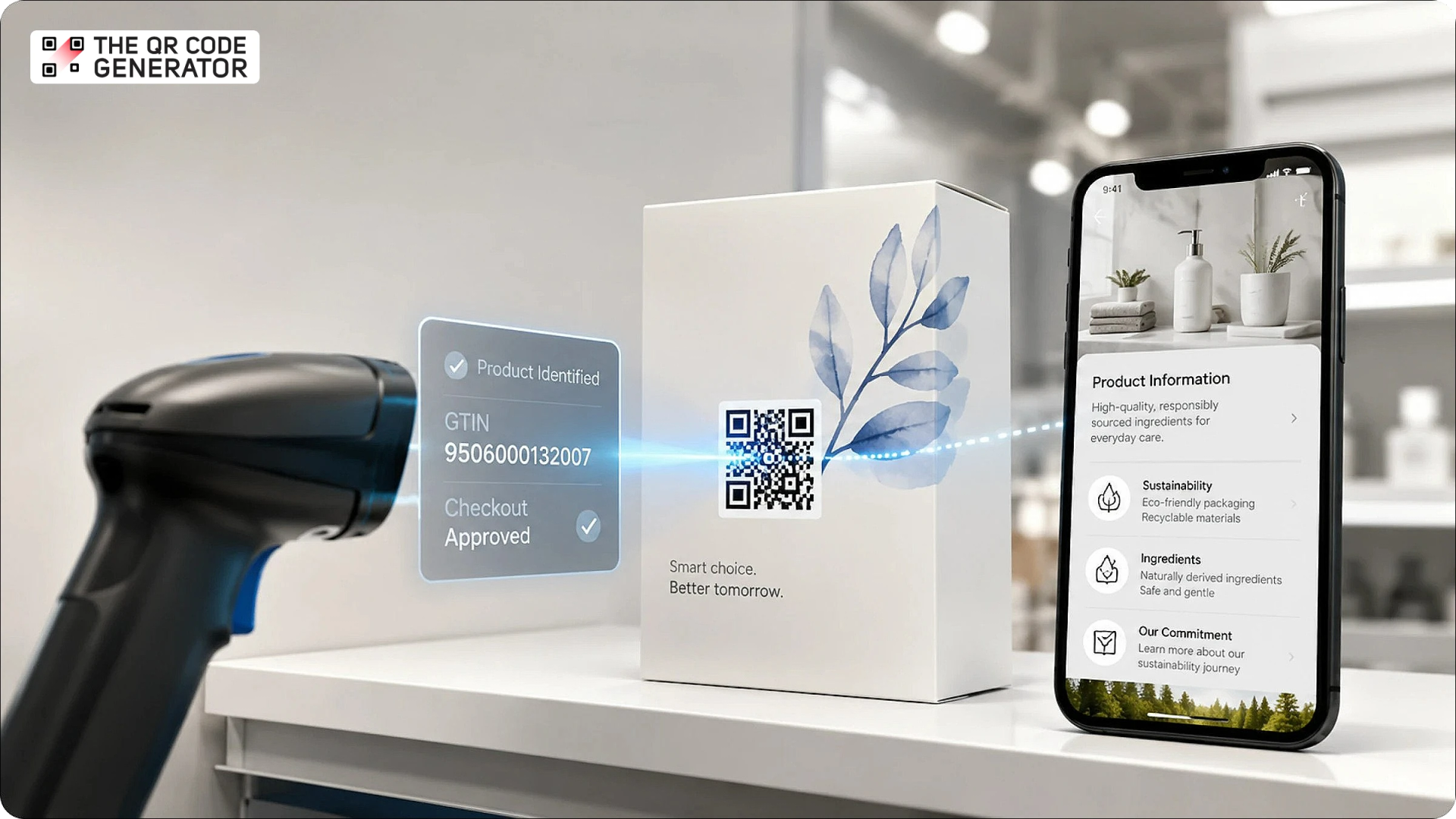
Your product already has a barcode. It may also have a QR Code. But as retailers prepare for Sunrise 2027 and expand support for 2D barcodes at checkout, many brands are discovering that a standard marketing QR Code is no longer enough.
A GS1 Digital Link QR Code is a next-generation 2D barcode that combines retail checkout, product traceability, and consumer engagement into a single scannable code. Instead of linking only to a webpage, it can carry standardized product identifiers such as a GTIN, batch number, serial number, and expiry date while directing different users to different destinations. The same code can help a retailer identify a product at checkout, help a consumer access product information, and help regulators retrieve traceability data when needed.
This guide explains how GS1 Digital Link QR Codes work, how they differ from traditional QR Codes, how to implement them, and what brands should know as Sunrise 2027 approaches.
What is a GS1 Digital Link QR Code?
A GS1 Digital Link QR Code is a standardized QR Code that uses a structured web URI to carry GS1 product identifiers such as a Global Trade Item Number (GTIN).
Unlike a traditional barcode, which is designed primarily for retail scanning, a GS1 Digital Link QR Code can serve multiple audiences from the same printed symbol. Retail scanners can read product identifiers for checkout and inventory management, while smartphones can open web experiences such as product pages, nutrition information, sustainability reports, or authentication portals.
The technology is based on the GS1 Digital Link standard, which defines how product data should be encoded into a web URL. This allows different systems to interpret the same code appropriately while maintaining a consistent identifier structure.
In simple terms, a traditional barcode identifies a product. A GS1 Digital Link QR Code identifies the product and links it to digital information.
Key terms to know
| Term | Meaning |
|---|---|
| GTIN | Global Trade Item Number used to identify a product |
| AI | Application Identifier used by GS1 to label product data |
| POS | Point-of-sale system used at retail checkout |
| Resolver | A service that routes scans to different destinations |
| Sunrise 2027 | GS1 initiative supporting retail adoption of 2D barcodes |
| QR Code powered by GS1 | GS1's name for a QR Code built on Digital Link syntax |
The three QR Code types brands often confuse
One of the biggest misconceptions surrounding GS1 Digital Link is that any QR Code can be used for retail checkout. In reality, there are three distinct categories of QR Codes, and understanding the difference is critical.
Standard marketing QR Codes
A standard marketing QR Code simply directs users to a webpage. For example, it might send someone to a:
- product page
- video
- restaurant menu
- promotional campaign
These QR Codes do not contain standardized product identifiers such as GTINs. While they work well for consumer engagement, retail systems cannot use them for inventory management, product identification, recalls, or traceability.
A QR Code that points to: https://yourbrand.com/product-page, is a marketing QR Code.
GS1-powered QR Codes
Some QR Codes contain GS1 data structures and identifiers such as GTINs, batch numbers, serial numbers, or expiry dates.
These QR Codes can support product identification and other operational use cases because the encoded data follows GS1 standards. However, they may not use the GS1 Digital Link web URI structure that enables web-based routing and digital experiences.
Think of these as QR Codes that carry GS1 data but are not necessarily full GS1 Digital Link implementations.
GS1 Digital Link QR Codes
A GS1 Digital Link QR Code combines standardized GS1 identifiers with a Digital Link URL structure that supports intelligent routing.
The same printed code can serve:
- Retail checkout systems
- Consumer smartphones
- Regulatory and traceability systems
- Supply chain applications
This makes it possible to replace multiple product codes with a single standards-based symbol.
A simple self-check is if your QR Code contains a structured URL that includes GS1 identifiers, such as: https://id.yourbrand.com/01/09521234543213, you are entering GS1 Digital Link territory. The symbol may look identical, but the data inside is fundamentally different.
How a GS1 Digital Link URL works
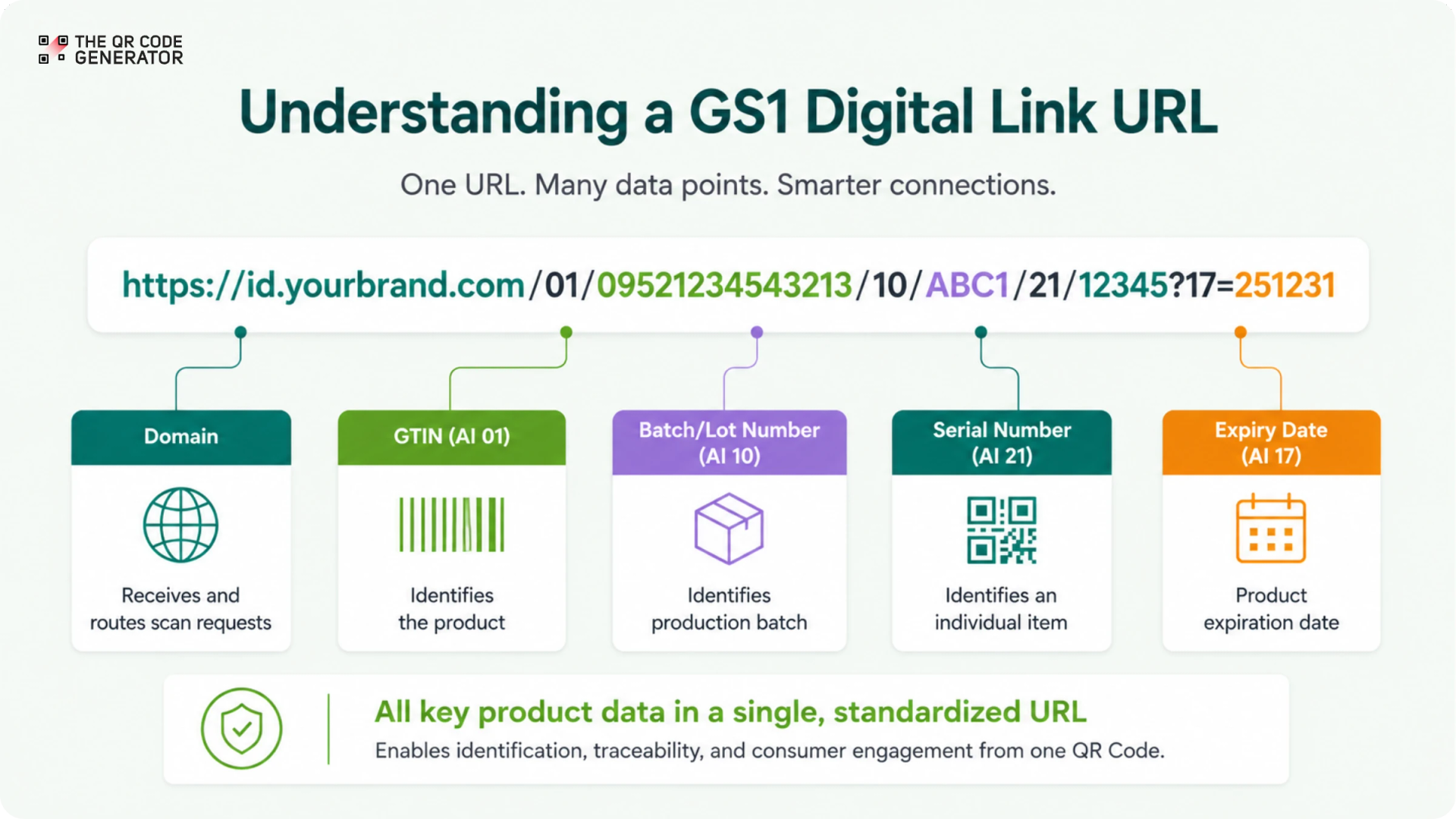
At the heart of every GS1 Digital Link QR Code is a structured URL that contains standardized product identifiers. Unlike a typical web address, a Digital Link URL can include information such as a product's GTIN, batch number, serial number, and expiry date.
A Digital Link URL might look like this:
https://id.yourbrand.com/01/09521234543213/10/ABC1/21/12345?17=251231
While the URL may appear complex, each section represents a specific piece of product information. The table below shows how the different components work together.
| URL component | Example value | What it represents |
|---|---|---|
| Domain | https://id.yourbrand.com | The web domain that receives the scan request. Many organizations use a dedicated subdomain for Digital Link infrastructure. |
| GTIN (AI 01) | /01/09521234543213 | The Global Trade Item Number that identifies the product. |
| Batch/Lot Number (AI 10) | /10/ABC1 | Identifies the production batch or lot. |
| Serial Number (AI 21) | /21/12345 | Identifies an individual product instance. |
| Expiry Date (AI 17) | ?17=251231 | Indicates the product's expiration date in YYMMDD format. |
Not every GS1 Digital Link QR Code contains all of these elements. The information included depends on the product, industry requirements, and intended use case.
How to create a GS1 Digital Link QR Code
Creating a GS1 Digital Link QR Code involves more than generating a QR Code symbol. Brands need valid GS1 identifiers, a standards-compliant URL structure, and a method for routing scans appropriately.
Step 1: Obtain a GS1-issued GTIN
Every Digital Link implementation begins with a GTIN. If your products already use UPC or EAN barcodes, you may already have GTINs assigned through your local GS1 Member Organization.
Step 2: Decide what information to encode
Not every product requires the same data elements. Depending on your use case, you may choose to include:
- GTIN (AI 01)
- Batch or lot number (AI 10)
- Serial number (AI 21)
- Expiry date (AI 17)
Only include information that serves a business purpose. Adding unnecessary data increases QR Code density and may require larger print sizes.
Step 3: Build a compliant Digital Link URL
Using your identifiers, construct a URL that follows GS1 Digital Link standards. The URL becomes the foundation of the QR Code and determines how downstream systems interpret the product data.
Step 4: Configure routing and destinations
Once the URL exists, you need a way to manage what happens after a scan. A retailer may only need the GTIN for checkout, while a consumer may expect nutritional information, product instructions, sustainability content, or loyalty experiences.
Brands can build their own resolver infrastructure or use a managed platform that handles URL generation, routing logic, analytics, and maintenance.
Step 5: Test before printing
Before deploying packaging at scale, validate the QR Code across:
- Smartphones
- Retail scanners
- Verification tools
- Print production samples
Testing before launch is significantly less expensive than reprinting packaging after deployment.
What does a resolver do, and why does it matter?
A GS1 Digital Link URL identifies a product, but a resolver determines where a scan goes next. When someone scans a GS1 Digital Link QR Code, the resolver receives the request and sends the user to the most appropriate destination.
Think of it as a traffic controller for product information. Without a resolver, every scan would lead to the same webpage. With a resolver, the same QR Code can support different experiences for different users, such as the table below.
| Who scans the QR Code? | What they might see |
|---|---|
| Consumers | Product information, recipes, sustainability details, loyalty programs, or promotions |
| Retailers | Product data used for pricing and inventory management |
| Supply chain partners | Information about shipments, batches, and traceability |
| Regulators | Product records needed for compliance and reporting |
The QR Code stays the same. The information shown can change based on who is scanning and what they need.
The web address inside the code begins with a domain, and that domain gets printed on the pack. Use a subdomain on your own website, such as id.yourbrand.com, rather than one owned by your QR Code provider. Switching providers later leaves every printed pack pointing at a domain you no longer control.
Build vs. buy: choosing a resolver strategy
Building your own resolver gives you full control over destinations, integrations, and reporting. It also makes hosting, maintenance, security, and uptime your responsibility, which works for large organizations with dedicated technical teams.
A managed platform covers all of that, so a Digital Link program starts without a development project.
Before choosing, check whether the platform builds GS1 Digital Link URLs for you and whether the QR Codes resolve on your domain.
Five common mistakes that can derail a GS1 Digital Link implementation
GS1 Digital Link is designed to make products easier to identify, track, and connect to digital information. But successful implementation depends on more than generating a QR Code.
Many deployment problems can be traced back to a handful of common mistakes. Understanding them early can save time, reduce costs, and help avoid packaging changes later.
1. Treating a marketing QR Code as a GS1 Digital Link QR Code
A traditional QR Code that points to a product webpage is not the same as a GS1 Digital Link QR Code.
Marketing QR Codes are designed to send users to a destination. GS1 Digital Link QR Codes are designed to identify a product using standardized data that retailers, distributors, and other systems can understand.
If a product contains only a marketing URL, it may miss some of the interoperability benefits that GS1 Digital Link is designed to deliver.
2. Focusing on the QR Code but forgetting the destination
Creating a GS1 Digital Link URL is only part of the process. The systems behind the QR Code also need to work correctly. If links break, redirects are misconfigured, or product information is unavailable, users may encounter errors even though the QR Code itself scans successfully.
A successful implementation depends on both the QR Code and the supporting infrastructure.
3. Adding more data than necessary
GS1 Digital Link can support a wide range of product information, including batch numbers, serial numbers, expiry dates, and other identifiers. While it may be tempting to include everything available, doing so can make the QR Code more complex and increase the amount of space it requires on packaging.
A good rule is to include only the information needed to support a specific business, operational, or regulatory requirement.
4. Overlooking print quality
Even the best Digital Link strategy can fail if the QR Code is difficult to scan. Low contrast, small symbol sizes, printing distortions, or insufficient spacing around the QR Code can all reduce scan reliability.
Before deploying at scale, test printed samples under real-world conditions to confirm that scanners and smartphones can read the code consistently.
5. Choosing the wrong location on the package
Where a QR Code is placed can be just as important as how it is designed. QR Codes positioned near folds, seams, curved surfaces, or package closures may become difficult to scan once the product reaches stores or consumers.
During packaging design reviews, treat the QR Code as a functional element of the package, not simply a graphic that can be placed anywhere.
What does Sunrise 2027 mean for brands?
Sunrise 2027 is a global GS1 initiative to help retailers transition from traditional one-dimensional barcodes to next-generation 2D barcodes, including QR Codes powered by GS1.
The long-term goal is simple: a single barcode should be able to work at checkout while also supporting richer product information, traceability, and consumer experiences.
For brands, this creates an opportunity to replace separate product and marketing codes with a single QR Code that can serve multiple purposes.
Is Sunrise 2027 mandatory?
No. Sunrise 2027 is not a law or government requirement. Instead, it is an industry-led effort supported by retailers, manufacturers, technology providers, and GS1 organizations worldwide.
That said, retailers set their own timelines. Speaking at GS1 US's Amplify event in 2025, Dillard's CTO Chuck Lasley said the retailer will set a minimum requirement for suppliers, a GTIN, and a serial number, and leave anything beyond that to the brand.
Does the UPC disappear in 2027?
No. The barcode already on your pack stays. GS1 recommends carrying both through the transition, a linear barcode and a 2D barcode holding the same GTIN. This is called dual-marking, and it keeps the product sellable in stores whose scanners are not ready. Dropping the linear barcode is a later decision that depends on how many of your retailers can scan 2D, not on a date.
Which 2D barcode should you use?
For consumer products, use a QR Code powered by GS1. Sunrise 2027 covers two 2D formats, and the other one is GS1 DataMatrix.
A GS1 DataMatrix carries the same GS1 identifiers but encodes them as element strings rather than a web URI. It is common in healthcare and industrial supply chains. Retail scanners read it reliably, phone cameras do not.
Both formats meet a retailer's requirements. Only the QR Code opens on a shopper's phone, which is why GS1 treats it as the preferred option for consumer engagement.
Why brands are preparing now
Many organizations are beginning their Digital Link journey before Sunrise 2027 arrives.
Starting early gives teams time to test packaging, validate scanning performance, and align internal systems without the pressure of a tight deadline. It also gives brands time to explore capabilities that traditional barcodes cannot support, such as product traceability, batch-level information, authentication, and consumer engagement experiences.
A phased rollout can help brands manage that transition. Many organizations start with a small group of high-volume products, validate the retail and consumer experience, and then expand across their broader product portfolio.
What can GS1 Digital Link analytics tell you?
One of the most significant advantages of Digital Link implementation is visibility. When a resolver is configured to capture scan data and connected analytics tools are in place, brands can gain insights that traditional barcodes cannot provide.
- Scan volume. Understand how frequently products are being scanned. This can reveal product interest levels and engagement trends over time.
- Geographic distribution. Scan locations can help identify where products are being interacted with, even if they were originally distributed elsewhere.
- Device information. Understanding the devices consumers use can help optimize post-scan experiences.
- Content engagement. When scans route to digital experiences, brands can measure page visits, time spent, conversions, and content interactions.
- Batch-level insights. Products that include batch or lot information may support more detailed traceability and operational analysis.
The specific analytics available will depend on the resolver platform, privacy requirements, and measurement tools used.
Start your GS1 Digital Link migration today
GS1 Digital Link QR Codes represent more than a replacement for traditional barcodes. They create a shared infrastructure that supports retail checkout, product traceability, consumer engagement, and future digital product experiences from a single printed symbol.
For brands preparing for the continued rollout of 2D barcodes, the path forward is relatively straightforward:
- Review your GTIN structure.
- Identify products suitable for implementation.
- Choose a resolver strategy.
- Validate packaging requirements.
- Launch with a small group of high-priority SKUs.
Organizations that begin planning now will have more time to test, optimize, and scale their Digital Link programs as industry adoption continues to grow.
Uniqode is a trusted GS1 solutions partner and has published a more comprehensive guide for CPG brands, including a readiness checklist timed to your next artwork freeze and case studies from PepsiCo and ISDIN.
Frequently Asked Questions
Is a regular QR Code the same as a GS1 Digital Link QR Code?
No. While the symbols may look identical, the data inside is different. A regular QR Code typically points to a webpage, while a GS1 Digital Link QR Code contains standardized product identifiers that can support retail, consumer, and traceability use cases.
Do I need a GTIN to create a GS1 Digital Link QR Code?
Yes. The GTIN is the primary identifier in the GS1 Digital Link framework and should be obtained from your local GS1 Member Organization.
Can I update what the QR Code shows without reprinting the packaging?
Yes. The printed QR Code remains the same, while the resolver controls the destination experience. This allows brands to update content without changing packaging artwork.
What happens when a GS1 Digital Link QR Code is scanned at checkout?
Retail systems can extract the GTIN and other relevant product data from the encoded Digital Link structure, allowing the product to be identified in the same way traditional barcodes are used today.
Is Sunrise 2027 a legal deadline?
No. Sunrise 2027 is an industry initiative focused on expanding support for 2D barcodes across retail environments. It is not a government mandate.
Can I create a GS1 Digital Link QR Code with a QR Code generator?
Some QR Code platforms support GS1 Digital Link generation, while others only create standard QR Codes that link to webpages. To create a GS1 Digital Link QR Code, you'll need valid GS1 identifiers and a platform or resolver that supports the GS1 Digital Link standard.
How much does implementing GS1 Digital Link cost?
Costs vary depending on factors such as GTIN licensing, resolver infrastructure, implementation complexity, and scan volume. Organizations can choose between custom-built solutions and managed platforms depending on their requirements and resources.
Will GS1 Digital Link QR Codes replace traditional barcodes?
GS1's Sunrise 2027 initiative is designed to support the adoption of 2D barcodes in retail environments. The long-term vision is that a single 2D barcode, such as a GS1 Digital Link QR Code, can perform many of the functions currently handled by traditional barcodes while also supporting consumer engagement and product information experiences.
However, the transition will take time. Many retailers are still upgrading systems to support 2D barcode scanning, and traditional barcodes will continue to coexist with 2D barcodes during the migration period.