
Are QR Codes Dead? No. Here's the 2026 Truth

Shanti Nair
Last updated: June 4, 2026
9 min read
QR Codes have been “dying” every year since Forbes ran the headline “Are QR Codes Dead?” in 2012. Meanwhile, people keep scanning them.
In 2026, over 100 million Americans are expected to use smartphone QR Code scanners. The QR Code market is expected to more than double in size to $33.14 billion in 2031 from 2026. For many businesses, QR Codes are no longer experimental marketing tools but part of daily operations.
So where does the skepticism come from? Simple: people remember the bad experiences. Codes that opened desktop-only websites, led to expired pages, and added friction instead of removing it. The problem was with poor execution and never with the QR Code itself.
This article separates the myth from the reality, explains what QR Codes are actually good at today, and shows how to use them in ways customers will genuinely find useful.
QR Codes were declared dead. The data says otherwise
Claims that QR Codes are dying have surfaced for more than a decade. The most famous example came in 2012, when Forbes asked, “Are QR Codes Dead?” At the time, the criticism seemed reasonable. Users had to download separate scanner apps, many codes led to poor mobile experiences, and adoption in Western markets was limited.
What those predictions throughout the history of QR Codes missed was that the problem was user experience, and it wasn’t the technology.
As smartphones improved, the biggest barriers disappeared. Apple added native QR Code scanning to the iPhone camera in 2017, Android followed with similar capabilities, and QR Codes became easier to use. The pandemic then accelerated adoption across restaurants, retail, transportation, and healthcare, turning QR Code scanning into a daily habit for millions of people.
The numbers tell the story. eMarketer projects that over 100 million US consumers will use smartphone QR Code scanners, while Uniqode’s State of QR Code 2026 reports that 70% of consumers use QR Codes at least once a month. Meanwhile, GS1, the global standards organization behind retail barcodes, has launched its Sunrise 2027 initiative to support QR Codes at point of sale (POS) alongside traditional UPC barcodes.
Technologies on the verge of extinction do not become part of the future of global retail infrastructure. Despite repeated predictions of their demise, QR Codes have continued to expand into more industries, use cases, and everyday interactions.
Key statistics at a glance
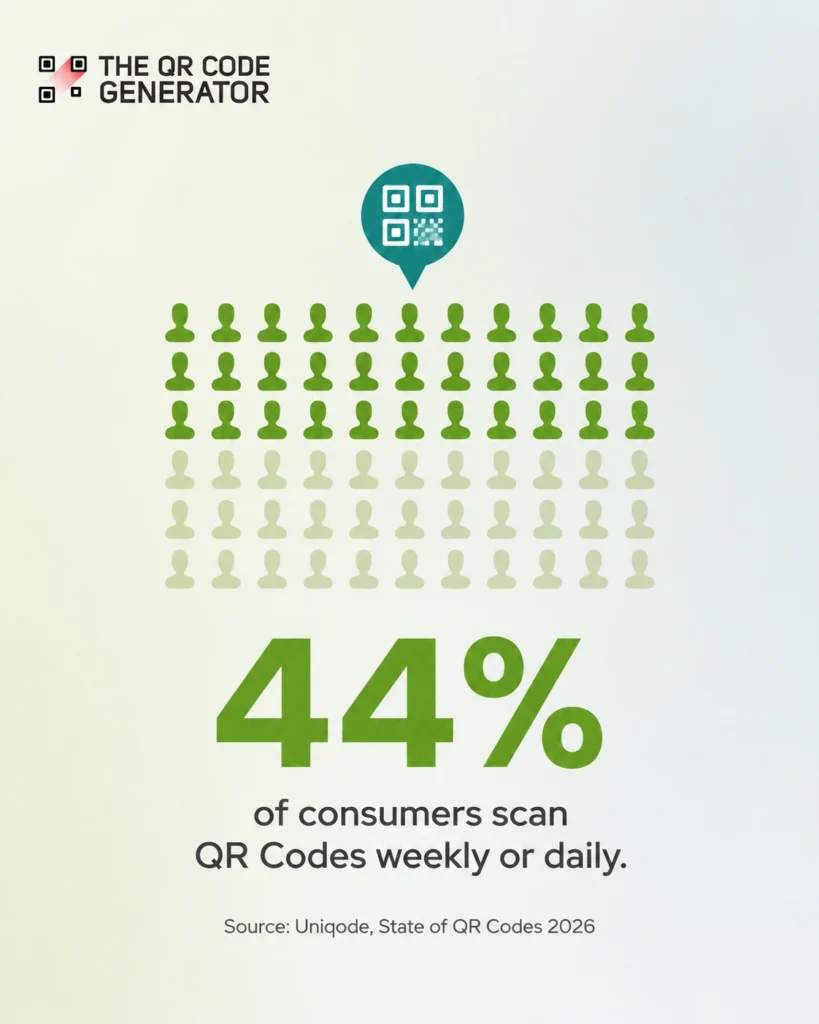
- 44% of consumers scan QR Codes weekly or daily; only 8% have never scanned one (Uniqode, State of QR Codes 2026).
- 79% of consumers are more likely to purchase a product that has a scannable QR Code providing additional product information (GS1 US).
- 98% of marketers report a positive impact with QR Codes, and 56% expect higher revenue from them this year (Uniqode, State of QR Codes 2026).
- The global QR Code payment market size was valued at $12.35 billion in 2024, growing at a CAGR of 19.7% from 2025 to 2034 (Polaris Market Research).
- The marketing and advertising segment is the fastest-growing QR Code application, expanding at a CAGR of 18.6% through 2031 (Mordor Intelligence).
The three mistakes that almost killed QR Codes
The technology was fine. The execution was terrible. QR Codes faced near death because of three specific implementation failures, none of which had anything to do with the encoding specification.
- First failure: the app-gate barrier. Before iOS 11 in 2017, scanning a QR Code required downloading a third-party scanner application. Most users scanned once, found the payoff mediocre, and deleted the app. The friction was in the four-step process required to use it, not in the code itself.
- Second failure: physically impossible placement. Marketers placed QR Codes on moving buses, billboard faces at 60 mph, and TV commercials that ran for four seconds. Scanning requires a stationary phone held close to the code. Placement on fast-moving or temporally compressed surfaces guaranteed a scan rate near zero.
- Third failure: non-mobile destination. When someone successfully scanned a QR Code in 2012, the URL opened a full desktop homepage on a 3.5-inch screen. The payoff was not worth the effort.
Three developments brought QR Codes back into mainstream use.
First, iOS 11 (September 2017) removed the biggest adoption barrier by building QR Code scanning directly into the iPhone camera. Users no longer needed to download a separate app before scanning, turning QR Codes into a one-step experience. Android followed suit in 2018.
Second, the pandemic-driven shift to contactless interactions in 2020 created an immediate need for touch-free menus, payments, check-ins, and information sharing. Businesses deployed QR Codes at scale, and consumers became comfortable using them in everyday life.
Third, dynamic QR Codes solved one of the biggest long-term reliability problems. Instead of encoding a fixed destination, a dynamic QR Code uses a redirect that can be updated at any time. If a website URL changes, the destination can be updated without reprinting the code, preventing the broken links that caused many early QR Code campaigns to fail.
Where QR Codes are actively growing in 2026
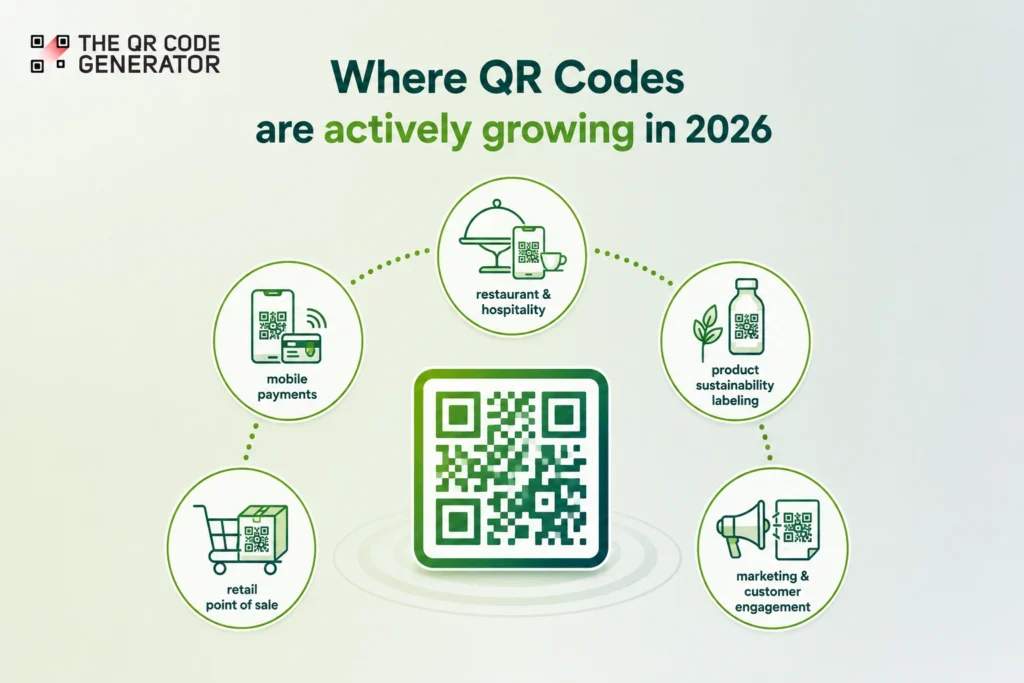
QR Codes are expanding across five sectors: retail point of sale, restaurant and hospitality, mobile payments, product sustainability labeling, and marketing and customer engagement.
Retail point of sale
The GS1 Sunrise 2027 transition is the single strongest growth signal. GS1’s Sunrise 2027 initiative sets 2027 as the industry milestone for all retail checkouts globally to support QR Codes as primary product identifiers alongside traditional UPC barcodes. Every major grocery and general merchandise chain is in scope. QR Codes will appear on tens of billions of product packages annually as a direct result of this transition.
Restaurant and hospitality
Restaurant chains now deploy QR Codes across three functions from a single scan: menus, loyalty enrollment, and contactless payment. Deloitte’s future of restaurants research documents the broad consumer shift toward digital ordering and frictionless experiences that has driven QR Code adoption across food service.
Mobile payments
China’s Alipay and WeChat Pay processed more than $30 trillion in combined mobile payment volume in 2023 alone, according to estimates from the People’s Bank of China. India’s UPI network handled over 13 billion transactions per month by early 2025, according to the National Payments Corporation of India. In the US, contactless adoption is expanding across major retail chains.
Product sustainability labeling
The EU Digital Product Passport regulation, phasing in from 2026, requires manufacturers to attach machine-readable product data (recyclability, material origin, carbon footprint) to physical items. QR Codes are the primary delivery mechanism. Every product in scope carries a QR Code as a regulatory requirement, not a marketing choice.
Marketing and customer engagement
Brands use QR Codes on product packaging, direct mail, event signage, and out-of-home advertising to connect offline audiences with digital experiences. Modern QR Codes in marketing are increasingly powered by dynamic destinations, allowing businesses to update content, track scan performance, and optimize campaigns without reprinting materials.
The one real threat to QR Codes: quishing and user trust
The only legitimate reason to be cautious about QR Codes in 2026 is security, not irrelevance.
QR Code phishing, known as quishing, is the act of replacing or overlaying legitimate QR Codes with malicious ones that redirect to phishing sites or trigger malware downloads. The FBI issued a public alert in January 2022 after a spike in tampered QR Code incidents. Criminals target high-traffic physical locations where QR Codes are placed, such as parking meters, restaurant tables, and public notice boards.
Quishing does not make QR Codes dangerous any more than phishing emails make email dangerous. The technology is neutral; the threat is in how malicious actors deploy it. So, how do you know if a QR Code is safe? Three checks reduce quishing risk significantly.
- Check the URL preview: Most smartphone cameras show the destination URL before opening it. A URL that doesn’t match the expected brand or shows an unfamiliar domain is a stop signal.
- Check the physical code: A sticker placed over a printed QR Code is the most common tamper method. A raised, crooked, or overlaid code is a reason not to scan.
- Check the request: A legitimate QR Code destination does not ask for login credentials or payment data immediately after scanning. A site that does is a red flag.
Quishing is a reason to be alert, not a reason to avoid QR Codes altogether. Businesses can further reduce risk by using secure QR Code management tools and following established security best practices.
For example, The QR Code Generator (TQRCG) supports enterprise deployments with certifications and controls, including SOC 2 Type 2, GDPR, and ISO-certified security standards. Combined with basic user awareness, these measures help preserve the convenience and trust that make QR Codes effective.
When a QR Code does “die”: causes and prevention
A QR Code stops working for three reasons. Each has a different cause and a different fix.
| Scenario | What happens | Why it fails | How to prevent it | Fix |
|---|---|---|---|---|
| Static QR Code + deleted destination | The QR Code stops directing users to the intended content. | The original URL, file, or webpage encoded in the QR Code no longer exists. | Use a dynamic QR Code for campaigns where destinations may change. | Create and print a new QR Code with an updated destination. |
| Dynamic QR Code + lapsed subscription | Scans stop resolving to the destination. | The redirect service hosting the dynamic QR Code becomes inactive after the subscription ends. | Choose a provider with clear QR Code retention policies and maintain active subscriptions for long-term campaigns. | Renew the subscription to restore the QR Code without reprinting. |
| Physical QR Code damage or poor printing | Scanners cannot reliably read the code. | The QR Code is too small, has insufficient contrast, is obscured, or has been physically damaged. | Follow QR Code print best practices for size, contrast, placement, and materials. | Reprint the QR Code using the correct specifications. |
Key takeaway: QR Codes rarely “die” on their own. Most failures result from broken destinations, inactive redirect services, or poor physical implementation, all of which can be prevented with dynamic QR Codes. The QR Code Generator gives every user two dynamic QR Codes on the free plan, with no expiry and no credit card required.
Read more: Do QR Codes Expire?
So, are QR Codes dead? Final verdict
No. QR Codes are not dead.
What’s dead is the version of QR Code marketing that treats a Code as a finishing touch rather than a channel. Dead-end landing pages. Unmeasured campaigns. Codes on highway billboards. Codes with no CTA. That version of QR Code marketing deserves its obituary.
The marketers who will win in the next two years are the ones who treat QR Codes the way they treat email or paid search: as a measurable, optimizable channel with clear input metrics and output goals.
If you are creating QR Codes for anything that lasts longer than a single print run, use dynamic QR Codes: they are the format that does not break when destinations change. The QR Code Generator offers two free dynamic QR Codes with no expiry and no credit card required.
Frequently Asked Questions
Are QR Codes still relevant in 2026?
Yes. QR Codes now show up across almost every industry and in daily interactions. Restaurants use them for menus and ordering. Retailers put them on packaging to share product details, promotions, and sustainability information. Hospitals use them for patient check-in and medication tracking. Transit systems use them for tickets. Marketers use them to connect print and digital campaigns and to measure results that were previously impossible to track. GS1 has set 2027 as the deadline for retailers to support QR Codes at checkout alongside traditional UPC barcodes, confirming their place in the future of global retail. The question is no longer whether QR Codes are relevant. It is whether you are using them well.
Why did people think QR Codes were dead?
Because for a long time, they genuinely were not working. Scanning required a separate app that most people refused to download, and when they did scan, codes usually led to desktop websites that loaded poorly on mobile. The criticism was fair. What those predictions got wrong was assuming the technology was the problem. When Apple added native scanning to the iPhone camera in 2017, the friction disappeared overnight.
What will replace QR Codes?
Nothing is replacing QR Codes at scale in the near term. Near-field communication (NFC) tags are used for premium packaging but cost more per unit. Augmented reality (AR) markers exist but lack the ubiquity of camera support that QR Codes have. QR Codes remain the dominant scan-and-link technology for now.
Are QR Codes becoming a legal requirement?
Increasingly, yes. In Europe, the EU's Digital Product Passport requires any company selling products on the EU market to carry product data accessible via QR Code, with deadlines rolling out from 2027 through 2030, depending on product category. In the US, the FDA's Food Traceability Rule identifies QR Codes as the recommended format for supply chain recordkeeping, with a compliance deadline of July 2028. GS1's Sunrise 2027 initiative adds a third layer, requiring global retailers to accept QR Codes at the point of sale alongside traditional UPC barcodes. For many businesses, QR Codes are no longer just a marketing tool. They are becoming a compliance requirement.
What is the FBI warning about QR Codes?
The FBI issued a public alert in January 2022, warning about quishing: criminals replacing legitimate QR Codes with malicious ones, redirecting to phishing sites. QR Codes are not inherently dangerous. Check the URL preview before tapping and inspect physical QR Codes for stickers over the original print.
Can a QR Code give my phone a virus?
No. A QR Code itself cannot contain a virus; it is just a data-encoded image. The risk is that a QR Code could link to a malicious website that attempts to install malware or steal credentials. The same caution that applies to clicking unknown links in emails applies to scanning unknown QR Codes. Always check the URL preview your camera shows before tapping through.
Why does my QR Code stop working?
Static QR Codes fail when the destination URL is deleted or the domain expires. Dynamic QR Codes stop working when the service subscription lapses; renewing restores the redirect without reprinting. Printed codes fail below 2.5 × 2.5 cm or at low contrast. Dynamic QR Codes eliminate the first two causes.